For The Archives of American Art/ Smithsonian Institution (1972)
Interview conducted on July 14 and 19, 1972
July 14, 1972
PAUL CUMMINGS: You were born in New Jersey?
ROBERT SMITHSON: Yes, in Passaic, New Jersey.
CUMMINGS: Did you come from a big family?
SMITHSON: No, I'm an only child.
CUMMINGS: So many artists I have been interviewing lately have been an only child. Did you grow up there, go to school there?
SMITHSON: I was born in Passaic and lived there for a short time, then we moved to Rutherford, New Jersey. William Carlos Williams was actually my baby doctor in Rutherford. We lived there until I was about nine and then we moved to Clifton, New Jersey. I guess around that time I had an inclination toward being an artist.
CUMMINGS: Were you making drawings?
SMITHSON: Oh yes, I was working in that area even back in the early phases in Rutherford. I was also very interested at that in natural history. In Clifton my father built what you could call a kind of suburban basement museum for me to display all my fossils and shells, and I was involved with collecting insects and…
CUMMINGS: Where did these shells come from?
SMITHSON: Oh, different places. We traveled a lot at that time. Right after the war in 1946 when we went out West I was about eight years old. It was an impressionable period. I started to get involved in collecting at that time. But basically I was pretty much unto myself in being interested in field naturalist things, looking for insects, rocks and whatever.
CUMMINGS: Did you have books around that were involved with these topics?
SMITHSON: Yes. And I went to the Museum of Natural History. When I was about seven I did very large paper constructions of dinosaurs which in a way, I suppose, relate right up to the present in terms of the film I made on The Spiral Jetty - the prehistoric motif runs throughout the film. So in a funny way I guess there is not that much difference between what I am now and my childhood. I really had a problem with school. I mean, there was no real understanding of where I was at, and I didn't know where I was at that time.
CUNMINGS: Did you like primary school or high school?
SMITHSON: No, I didn't. I grew rather hostile to school, actually, I started going to the Art Students League. I won a scholarship. In my last year of high school I managed to go only half way. I was just very put off by the whole way art was taught.
CUMMINGS: Really? In what way?
SMITHSON: Well, my high school teacher would come up with statements like - I remember this one quite vividly - that the only people who become artists are cripples and women.
CUMMINGS: This was a high school art teacher? What was their problem?
SMITHSON: Well, They seemed to have all kinds of problems. Everything was kind of restricted. There was no comprehension of any kind, no creative attitude. It was mostly rote - a very unimaginative teaching staff, constricted and departmentalized. At that point I didn't have any self-realization, so really couldn't tell, except that the Art Students League did offer me a chance to at least come in contact with other people. I made a lost of friends with people in the High School of Music and Art in New York.
CUMMINGS: Did you go to that school?
SMITHSON: No, but I had a lot of friends from there, and we had a sketch class together. Every Saturday in the last two years of high school I went to Isaac Osier's studio. We used to sketch each other and we'd talk about art and go to museums. And that was a very important thing for me, getting out of that kind of stifling suburban atmosphere where there was just nothing.
CUMMINGS: How did you get the scholarship to the League?
SMITHSON: I applied for that. I did a series of woodcuts, rather large woodcuts. I remember one of them was called Teenagers on 42nd Street. It was done in a kind of German Expressionist style. I was about sixteen when I did that.
CUMMINGS: Did you have art books and things at home?
SMITHSON: Yes. I kept coming into New York and buying art books. I was pursuing it on my own.
CUMMINGS: Did you go to museums and galleries?
SMITHSON: Yes. The first museum show I saw at the Museum of Modern Art was The Fauves' exhibition. I was about sixteen. I had that attitude. And then I went back to Clifton High School and tried to present those ideas but they didn't quite jell.
CUMMINGS: Were you interested in other classes in school?
SMITHSON: Well, I was somewhat interested in writing, although at that time I had a sort of writer's block, you know, I couldn't quite get it together. I had a good oral sense; I liked to talk. I remember giving a talk, I think in my sophomore year in high school, on The War of Worlds, the H.G. Wells thing. And I gave a talk on the proposed Guggenheim Museum. Things like that interested me. But I found those things that interested me really didn't coincide with school, so I became more and more disenchanted and more and more confused.
CUMMINGS: You had no instructor in any class who picked up on any of those things?
SMITHSON: No. It was all very hostile and cramped, and it just alienated me more and more to the point where I grew rather hostile to the whole public school situation. In a very, very definite way I wanted nothing to do with high school, and I had no intention of going to college.
CUMMINGS: What about the writing? When did that start?
SMITHSON: That started in 1965 - 1966. But it was a self-taught situation. After about five years of thrashing around on my own, I started to pull my thoughts together and was able to begin writing. Since then, I guess I've written about twenty articles.
CUMMINGS: Do you find it augments your work? Or is it separate from it?
SMITHSON: Well, it comes out of my sensibility - it comes out of my own observation. It sort of parallels my actual art involvement. The two coincide; one informs the other.
CUMMINGS: How did you find the art scene in the fifties?
SMITHSON: That was a very crucial time. Everything was very repressed and stupid; there was no art context as we know it now. There weren't any galleries to speak of (when I was sixteen or seventeen). I was very much encouraged by Frederica Beer-Monti who ran the Artists Gallery. She was an Austrian woman of the circle of Kokoschka and that crowd, and she had been painted by a lot of those people. She was very encouraging.
CUMMINGS: How did you meet her?
SMITHSON: I took my woodcuts to the gallery. It was run by Hugh Stix and his wife who were very encouraging. It was a non-profit gallery. I would have discussions there with Owen Ratchliff, who was sort of the director. I would say that in a way they gave me an opportunity to work for myself.
CUMMINGS: You had a show with them at one point?
SMITHSON: I had a show with them. I was the youngest artist to ever show there. And I felt - well, you know, if I can show at age nineteen, keep on going. I've always been kind of unreachable, I guess, especially at that point. I met other people, - I was friendly with the son of Meyer Levin, Joe Levin, who went to Music and Art High School. I remember Meyer Levin saying that I was the type of person that couldn't go to school, that I would either make it very big or else go crazy.
CUMMINGS: Nice alternatives. How did you like that Art Students League? What did you do there?
SMITHSON: It gave me an opportunity to meet younger people and others who were sort of sympathetic to my outlook. There wasn't anybody in Clifton who I was close to except for one person-Danny Donahue. He got interested in art, but eventually he did go crazy and was killed in a motorcycle and just … I mean it was a very difficult time, I think, for people to find themselves.
CUMMINGS: That was in the fifties?
SMITHSON: In the fifties, yes, This was, I'd say, around 1956-57. I spent a short period-six months-in the Army.
CUMMINGS: Were you drafted? Or did you join?
SMITHSON: No, I joined. Actually I joined with Danny Donahue, Joe Levin, and Charlie Hasloff. Charlie is a poet from Dusseldorf. Both Danny and Joe were excluded and that left Charlie and me. The reason I joined was because it was a special plan; it was a kind of art group called Special Services.
CUMMINGS: Oh, really! What was that?
SMITHSON: Well, strangely enough, John Cassavetes was in this group. And Miles Kruger, who is an expert on nostalgia.
CUMMINGS: Oh,yes! The Amercian musical stage.
SMITHSON: Right, You know him?
CUMMINGS: Oh, for years! Yes.
SMITHSON: Well, in a way he was responsible for cueing me into the situation. So it turned out that I went to Fort Knox, went through basic training, spent some unhappy hours in clerk-typist's school, and then ended up as sort of artist-in-residence at Fort Knox. I did watercolors of local Army installations for the mess hall. It was a very confusing period. Another important relationship I had was with a poet named Alan Brilliant. I stayed at his place up on Park Avenue and 96th Street, in the El Bario area. He was involved with publishing poet. I met him through Joe Levin.
CUMMINGS: Was Miles with you all through this military period?
SMITHSON: I spent a few times with Miles at the Rienzi Cafe down in the village were we had discussions. That sort of thing. I don't know him that well. I think this was around 1956. I mean that was an interesting period for me. I'm trying to put it together right now.
CUMMINGS: What about the poet though- Brilliant?
SMITHSON: Brilliant married a novelist , Teo Savory, moved out to California, and became a little magazine publisher-The Unicorn Press. In that group I met Hubert Selby, who wrote Last Exit to Brookelyn, Franz Kline, a lot of people from Black Mountain. That was an important thing.
CUMMINGS: At the Cedar Bar.
SMITHSON: At the Cedar Bar. Carl Andre said one time that that was where he got his education. In a way I kind of agree with him.
CUMMINGS: A lot of people did.
SMITHSON: I think it was a kind of meeting place for people who were sort of struggling to figure out who they were and where they were going.
CUMMINGS: The late fifties was also sort of the heyday of the Tenth Street galleries.
SMITHSON: That's right. I knew a lot of people involved in that. Although I had had this show at the Artists Gallery, I was somewhat unsatisfied. The show was reviewed in Art News by Irving Sandler, but I just didn't feel satisfied. Strangely enough, the work sort of grew out of Barnett Newman; I was using stripes and then gradually Introduced pieces of paper over the stripes. The stripes then sort of got into a kind of archetypal imagistic period utilizing images similar, I guess, to Pollock's She-Wolf Period and Dubuffet and certain mythological religious archetypes.
CUMMINGS: Well, that's something like the images in the show in Rome then-right?
SMITHSON: Yes. That comes out of that period. Charles Alan offered to put me in a show in his gallery in New York. And the reason I got the show in Rome was because of the painting called Quicksand. It's an abstraction done with gouache. I think Charles Alan still owns it. It was fundamentally abstract, sort of olives and yellow and pieces of paper stapled onto it; it had a kind of incoherent landscape look to it.
CUMMINGS: Did you know Newman's work? Were you intrigued by that kind of thing?
SMITHSON: Yes I did see Newman's work. But emotionally I wasn't -I mean I responded to it, but this latent imagery was still in me, a kind of anthropomorphism; and, you see, I was also concerned with Dubuffet and de Kooning in terms of that kind of submerged…
CUMMINGS: Where had you seen Dubuffet? Because he was not shown that much here.
SMITHSON: Oh, I think he had a lot of things in the Museum of Modern Art. And I'd seen books. I think he was being shown at one of the galleries. I can't remember exactly which one. I'am pretty sure I saw things of his in the Museum of Modern Art. I was around twenty at this time.
CUMMINGS: As long as we're talking about galleries and museums, which galleries interested you most? Do you remember the ones that you went to in those days?You've mentioned Charles Alan and the Artists Gallery.
SMITHSON: Yes. Well, a lot of the galleries hadn't opened yet. I was very much intrigued by Dick Bellamy's gallery-the Hansa Gallery. When I was still going to the Art Students League I used to drop around the corner to see Dick Bellamy. He was very encouraging. Also in the late fifties I moved to Montgomery Street; there I was living about three blocks from Dick Bellamy. He was the first one to invite me to an actual opening. I believe it was an Allan Kaprow opening at the Hansa Gallery. At the time I was trying to put together a book of art and poetry with Allan Graham (Which never manifested itself) so Dick had suggested that I go to see these new young artists Jasper Johns and Rauschenberg. I remember having seen their work at The Jewish Museum in a small show. And also in this book I wanted to include comic strips. I was especially interested in the early issues of Mad magazine-"Man Out of Control". Then there was an artist who was interesting, somebody who had a kind of somewhat psychopathic approach to art; his name was Joseph Winter and he was showing at the Artists Gallery; I wanted to include him. I also met Allen Ginsberg sand Jack Kerouac at that time. I met lots of people through Dick Bellamy. Let me see what else. I worked at the Eighth Street Bookshop too.
CUMMINGS: Oh, really? When was that?
SMITHSON: I would say in 1958, I think right about that period, give or take a year.
CUMMINGS: To kind of go back a bit, who did you study with at the League?
SMITHSON: Oh, John Groth, who was an illustrator.
CUMMINGS: How did you select him?
SMITHSON: Well, you see, I could only go on Fridays. I also studied with somebody named Bove during the week. But I just selected him - he had a sort of loose way of drawing and I was interested in drawing. In the early years of high school I had ideas of being an illustrator of some sort.
CUMMINGS: Making it a useful paying career.
SMITHSON: Yes. But John Groth was worthwhile teacher and he had a good sense of composition. I always did my work at my home. I did sketching from models and things at the League, but basically I did all my work at home. I worked in caseins. I still have some of those works from that period.
CUMMINGS: How did your family like this development?
SMITHSON: They didn't like it.
CUMMINGS: There was no encouragement?
SMITHSON: Well, you know, they just didn't see it as a paying enterprise. They saw it as a rather questionable occupation, Bohemian, you know, that sort of thing. Although my great-grandfather was a rather well-known artist around the turn of the century. He did interior plaster work in all the major municipal buildings in New York: the Museum of Natural History, the Metropolitan; he did the entire subway system.
CUMMINGS: What was his name?
SMITHSON: His name was Charles Smithson. Well, of course since then all the work has been torn out of the subways. I guess it was of the period that Lewis Mumford called "The Brown Decade"; you know, that kind of work. There was an article written about him in an old journal from around 1900. He was also involved in sort of public art. My grandfather worked with him for a while, but then the unions came in and that sort of craft work went out and prefab work came in. Then the Depression wiped out my great-grandfather and my grandfather who was sort of a poet actually -
CUMMINGS: What was his name?
SMITHSON: His name was Samuel Smithson. Incidentally, there was somebody at Columbia who claimed that all the Smithsons were related to the founder of the Smithsonian Institution, as a matter of fact.
CUMMINGS: Well, you see how small the world is.
SMITHSON: But I don't know about that.
CUMMINGS: It's only two hundred years ago.
SMITHSON: Well, he had no offspring. I don't know - I never could understand it but this man whose name is I.M.Smithson is working at Columbia on all of the Smithsons, and how they're related to the Smithsonian one. As a matter of fact, he called me up as a result of the flyer from the Artists Gallery which one of the students gave him. But I never heard anything more about that.
CUMMINGS: He may well be up there digging away somewhere.
SMITHSON: Right. My father worked for Auro-lite. I do remember some interesting things that he used to bring home - like films - where they had all these car parts sort of automated, you know, like marching spark plugs and marching carburetors and that of thing. It's very vivid in my mind. Later on he went into real estate and finally into mortgage and banking work. He just never had the artistic view. On my mother's side I'm Middle European of diverse origins, I suppose mainly Slavic.
CUMMINGS: Well, what happened? You had this exhibition at the Artists Gallery. Did that help your parents' interest in your work?
SMITHSON: Yes. Well, they came to see it and try to understand what their son was getting into. They've always been sympathetic. I mean they're really pretty good to me - I had a brother who died before I was born. My father did take me on trips. Actually, no looking back on it, he did have real sense of a kind of, you know, American idea of the landscape, but in an American way; I mean he loved to travel. He hitchhiked around the country, rode the rails and everything when he was younger; he sort of had a feeling for scenic beauty, but couldn't understand modern art.
CUMMINGS: He liked Bierstadt paintings.
SMITHSON: Yes. Well, that sort of thing.
CUMMINGS: How much of the country have you traveled around? I know you've been here, there, and everywhere.
SMITHSON: I sort of concentrated on it in my childhood and adolescence. Well, my first major trip was when I was eight years old and my father and mother took me around the entire United States. Right after World War II we traveled across the Pennsylvania Turnpike out through the Black Hills and the Badlands, through Yellowstone, up into the Redwood forests, then down the Coast, and then over to the Grand Canyon. I was eight years old and it made a big impression on me. I used to give little post card shows. I remember I'd set up a little booth and cut a hole in it and put post cards up into the slot and show all the kinds these post cards.
CUMMINGS: Oh. The post cards you picked up on your travels?
SMITHSON: Yes. And then on my mother's side it's obscure. Her maiden name was Duke from Austria, that area. Her father was a wheelmaker.
CUMMINGS: Then there's a strong craft tradition behind you- using materials and making objects.
SMITHSON: Yes. I guess there is something to that.
CUMMINGS: Let's see, you went to the Brooklyn Museum School at one point?
SMITHSON: Yes, I got a scholarship there too. I went there on Saturdays, but I didn't go there too long. It was kind of far to go there. I went to life classes with Isaac Soyer again; well, mainly we used to gather at his place. His studio was up near Central Park. We'd do sketching. I think I went there for may beabout three months.
CUMMINGS: How was the Brooklyn Museum? Did you like that?
SMITHSON: No. I can't say that. I really responded that much. I think the strongest impact on me was the Museum of Natural History. My father took me there when I was around seven. I remember he took me first to the Metropolitan which I found kind of dull. I was very interested in natural history.
CUMMINGS: All the animals and things.
SMITHSON: Yes.
CUMMINGS: Did they have the panoramas then? I don't remember…
SMITHSON: Oh, yes. I mean it was just the whole spectacle, the whole thing- the dinosaurs made a tremendous impression on me. I think this initial impact is still in my psyche. We used to go the Museum of Natural History all the time.
CUMMINGS: That was your museum rather than the art museum?
SMITHSON: Yes.
CUMMINGS: Were your parents interested in that, or was it because you were interested?
SMITHSON: Yes-well, my father liked it. My father sort of liked the dioramas and things of that sort, because of the painstaking reality. Looking back on that, I think he took me to the Metropolitan thinking that was the Museum of Natural History- I could be wrong but I think I remember his saying: Oh, well, we can go to an interesting museum now. For me it was much more interesting. Then from that point on I just got more and more interested in natural history. At one point I thought of becoming either a field naturalist or a zoologist.
CUMMINGS: Did you go to college anywhere?
SMITHSON: No.
CUMMINGS: I didn't think you did. So what happened then? When did you move to New York?
SMITHSON: I moved to New York in 1957, right after I got out of the Army. Then I hitchhiked all around the country. I went out West and visited the Hopi Indian Reservation and found that very exciting. Quite by chance, I was privileged to see a rain dance at Oraibi. I guess I was about eighteen or nineteen.
CUMMINGS: Had you been to the Museum of the American Indian ever?
SMITHSON: No.
CUMMINGS: You hadn't? So it was a new experience.
SMITHSON: Yes. Well, you see, again, I knew about Gallup, New Mexico. I knew about and made a special point of going to Canyon de Chelly. I had seen photographs of that. I hiked the length of Canyon the Chelly at that point and slept out. It was the period of the beat generation. When I got back, On the Road was out, and all those people were around, you know, Jack Kerouac and Allen Ginsberg, both of whom I met. And Hubert Selby, I knew him rather well; I used to visit him out in Brooklyn and we listened to jazz and that sort of thing. He was strange person. I mean there was something weird about him. In fact he billed himself as an Eisenhower Republican, lived in a highrise. He had lung trouble, I think he had only a quarter of a lung left or something. At one point he tried to commit suicide. I don't know - it just got very bad. He was trying to get his book published at that time. The way I met him - I was sitting at a table at the Cedar Bar, I had read a chapter from his book and I praised it to, I think it was Jonathan Williams of the Black Mountain Press. It just happened that Hubert was sitting there (Cubby as he was called) and - well, of course he was taken with the fact that somebody liked his story that much.
CUMMINGS: How did you find the Cedar? Was that just through wandering around the Village?
SMITHSON: How did I find the Cedar? No, I think people just sort of gravitated to it. Tenth Street was very active. I can't remember exactly how I discovered it. But I think perhaps, again through Dick Bellamy or Miles Forst, Dody Muller, people like that, you know. I knew Edward Avedisian to at that time. And Dick Baker who worked for Grove Press and became a Zen monk.
CUMMINGS: You never showed in Tenth Street, did you, in any of those galleries?
SMITHSON: No. By that time, I was even more confused, I mean I had a certain initial kind of intuitive talent in terms of sizing up the situation and being influenced. But I had to work my way out of that. It took me three years. And then I was exposed to Europe through my show at the George Lester Gallery in Rome which had a tremendous impact on me.
CUMMINGS: How did that happen?
SMITHSON: As I said, he offered me a show on the basis of that painting Quicksand that was shown at the Alan Gallery. At that time I really wasn't interested in doing abstractions. I was actually interested in religion, you know, and archetypal things, I guess interested in Europe and understanding the relationship of…
CUMMINGS: Did you go to Europe then?
SMITHSON: Yes, I went to Europe in 1961. I was in Rome for about three months. And I visited Siena. I was very interested in the Byzantine. As a result I remember wandering around through these old baroque churches and going through these labyrinthine vaults. At the same time I was reading people liking William Burroughs. It all seemed to coincide in a curious kind of way.
CUMMINGS: What other things were you reading besides Burroughs?
SMITHSON: T.S.Eliot then had a big influence on me, of course, after going to Rome. So I had to wrestle with that particular problem of tradition and Anglo- Catholicism, the whole number. And then I was getting to know Nancy- we met in New York in 1959…
CUMMINGS: What was it like being a young American in Rome and having a show?
SMITHSON: It was very exciting to me. I was very interested in Rome itself. I just felt I wanted to be a part of that situation, or wanted to understand it.
CUMMINGS: In what way? What were the qualities?
SMITHSON: I wanted to understand the roots of- I guess you could call it Western civilization really, and how religion had influenced art.
CUMMINGS: What got you interested or involved in religion at that point? I find that interesting in the context of the people you knew, because it wasn't generally something they were all that interested in.
SMITHSON: Well, I was reading people- like I read Djuna Barnes' Nightwood, T.S,Eliot , and Ezra Pound. There was a sense of European history that was very prevalent. Also I was very influenced by Wyndham Lewis.
CUMMINGS: Oh, really? But Pound is not particularly involved with…
SMITHSON: Well, he was interested in a kind of notion of what Western art grew out of and what happened to it. I mean it was a way of discovering the history of Western art in terms of the Renaissance and what preceded it, especially the Byzantine.
CUMMINGS: Well, you mean the ritual and the ideas and all those things?
SMITHSON: Yes, and I think a kind of Jungian involvement - like Jackson Pollock's interest in archetypal structures. I was just kind of interested in the facade of Catholicism.
CUMMINGS: But were you interested in Jung or Freud particularly?
SMITHSON: Yes, I was at that time.
CUMMINGS: You read their writings and things?
SMITHSON: Yes.
CUMMINGS: Did you ever go into analysis?
SMITHSON: No.
CUMMINGS: How did you find that those activities worked for you? Did they answer questions for you? Or did they just pose new ones?
SMITHSON: I think I got to understand, let's say, the mainspring of what European art was rooted in prior to the growth of Modernism. And it was very important for me to understand that. And once I understood that I could understand Modernism and I could make my own moves. I would say that I began to function as a conscious artist around 1964-65 I think I started doing works then that were mature. I would say that prior to the 1964-65 period I was in a kind of groping, investigating period.
CUMMINGS: I'm curious about the show at the George Lester Gallery.
SMITHSON: The three paintings which were probably the best, were sort of semi-abstractions based on a rough grid- one was called. The Inferno, another was called Purgatory, another was called Paradise.
CUMMINGS: Dante-esque.
SMITHSON: It was Dante-esque, but- it was a rough irregular grid type painting with sort of fragments of faces and things embedded in this grid. Other things were kind of iconic, tending toward a kind of Byzantine relationship. I was also very much interested in the theories of T.E. Hulme; as I said, that whole circle, that whole prewar circle of Modernism.
CUMMINGS: What artists were you interested in at that point?
SMITHSON: I really wasn't- I was really interested in the past at that point.
CUMMINGS: It was an interest in modern literature and old art?
SMITHSON: Initially- well, when I was nineteen- the impact was Newman, Pollock,Dubuffet, Rauschenberg, de Kooning; even Alan Davie who I had seen I think at the Viviano Gallery; the whole New York School of painting. I felt very much at home with that when I was in my late teens, but when I rejected it in favor of a more traditional approach. And this lasted from maybe 11960 to1963.
CUMMINGS: Why do you think you rejected those things?
SMITHSON: I just felt that -they really didn't understand, first of all, anthropomorphism, which had constantly been lurking in Pollock and de Kooning. I always felt that a problem. I always thought it was somehow seething underneath all those masses of paint. And even Newman in his later work still referred to a certain kind of Judeo-Christian value. I wasn't that much interested in a sort of Bauhaus formalist view. I was interested in this kind of archetypal gut situation that was based on primordial needs and the unconscious depths. And the real breakthrough came once I was able to overcome this lurking pagan religious anthropomorphism. I was able to get into crystalline structures in terms of structures of matter and that sort of thing.
CUMMINGS: What precipitated that transition, do you think?
SMITHSON: Well, I just felt that Europe had exhausted its culture. I suppose my first inklings of a more Marxists view began to arise, rather than my trying to reestablish traditional art work in terms of the Eliot-Pound-Wyndham Lewis situation. I just felt there was a certain naivete in the American painters-good as they were.
CUMMINGS: Did you get interested in Marxism?
SMITHSON: No. It was just sort of flicker. I mean began to become more concerned with the structure of matter itself, in crystalline structures. The crystalline structures gradually grew into mapping structures.
CUMMINGS: In a visual way, or in a conceptual way?
SMITHSON: Visual, because I gave up painting around 1963 and began to work plastics in kind of crystalline way. And I began to develop structures based on a particular concern with the elements of material itself. But this was essentially abstract and devoid of any kind of mythological content.
CUMMINGS: There was no figurative overtone to it.
SMITHSON: No, I had completely gotten rid of that problem. I felt that Jackson Pollock never really understood that, and although I admire him still, I still think that that was something that was always eating him up inside.
CUMMINGS: But it's interesting because there is a development away from traditional kinds of imagery and yet an involvement with natural materials…
SMITHSON: Well, I would say that begins to surface in 1965-66. That's when I really began to get into that, and when I consider my emergence as a conscious artist. Prior to that my struggle was to get into another realm. In 1964, 1965, 1966 I met people who were more compatible with my view. I met Sol LeWitt, Dan Flavin, and Donald Judd. At that time we showed at the Daniels Gallery; I believe it was in 1965. I was doing crystalline type works and my early interest in geology and earth sciences began to assert itself over the whole cultural overlay of Europe. I had gotten that our of my system.
CUMMINGS: Out of chaos comes…
SMITHSON: Yes. Well, out of the defunct, I think, class culture of Europe I developed something that was intrinsically my own and rooted to my own experience in America.
CUMMINGS: Have you been back to Europe since that?
SMITHSON: Yes, I have been back to Europe. I did Broken Circle - Spiral Hill in Holland in 1971. I consider it a major piece.
JULY 19, 1972
CUMMINGS: Would you like to say something about your visit with William - Carlos Williams?
SMITHSON: Yes. Well, this took place I think in either 1958 or 1959. William Carlos Williams was going to do an Introduction for Irving Layton's book of poems. So I went out to Rutherford with Irving Layton. It wasn't for an interview, he was in pretty bad shape at that time, he was kind of palsied. But he was rather interesting - Once he found out that we weren't going to be doing any articles, he was pretty open. Sophie Williams was there too. He said that he enjoyed meeting artists more than writers.
CUMMINGS: Ob, really? Why?
SMITHSON: He just found them more interesting to talk to.
CUMMINGS: Contrast, maybe.
SMITHSON: As it turned out, he had a whole collection of paintings by Marsden Hartely, Demuth, Ben Shahn; and also paintings by Hart Crane's boy friend, which I thought was interesting. He bought them -
CUMMINGS: I can't remember who that was.
SMITHSON: I can't remember his name either. He talked about Ezra Pound, which I thought was interesting apropos of all the controversy about Ezra Pound. And it turned out that when Pound was giving his broadcasts in Italy he said something to the effect that "Old Doc Williams in Rutherford, New Jersey will understand what I mean." So the very next day the FBI descended on Williams' house and he had to explain that he wasn't involved in that kind of political attitude. He went on to talk about the other poets, but he seemed somewhat estranged from them. Let me see what else. Oh, he didn't seem to have much liking for T.S. Eliot. And he said he remembers Hart Crane inviting him over to New York for all his fairy parties; that sort of thing. And what else? - well, he showed us all these paintings. There was painting that somehow reminded me of a painting by Duchamp. Demuth did like two dogs running around sniffing each other's asses. He talked a lot about Allen Ginsberg coming out at all hours of the night, and having to spring poets out there. Allen Ginsberg comes from Paterson, New Jersey. I guess the Paterson area is where I had a lot of my contact with quarries and I think that is somewhat embedded in my psyche. As a kid I sued to go and prowl around all those quarries. And of course, they figured strongly in Paterson. When I read the poems I was interested in that, especially this one part of Paterson where it showed all the strata levels under Paterson. Sort of proto-conceptual art, you might say. Later on I wrote an article for Artforum on Passaic which is a city on the Passaic River south of Paterson. In a way I think it reflects that whole area. Williams did have a sense of that kind of New Jersey landscape.
CUMMINGS: Was he amused at the idea that you were one of his children in a sense?
SMITHSON: Oh, yes, he said he remembered me, he remembered the Smithsons. He was amused at that actually, yes… There are certain things that I know I'm forgetting. But it was a kind of exciting thing for me at that time. And what else? Where were we?
CUMMINGS: I'm curious also, about your interest in religion and theology since it was mentioned in so many kinds of oblique ways on the other side of the tape. Did you have a very strict religious upbringing?
SMITHSON: No. Actually, I was very skeptical even through high school. In high school they thought I was a Communist and an atheist, which I was actually. That problem always seemed to come up. In fact, while I was still going to high school, my friend Danny Donahue and did a joint project, a tape recording for a psychology class. And it was essentially a questioning of the premises of religion drawn mainly from Freud and H.G. Wells.
CUMMINGS: That's good combination.
SMITHSON: I guess I was always interested in origins and primordial beginnings, you know, the archetypal nature of things. And I guess this was always haunting me all the way until about 1959 and 1960 when I got interested in. Catholicism through T.S. Eliot and through that range of thinking. T.E. Hulme sort of led me to an interest in the Byzantine and in notions of abstraction as a kind of counterpoint to the Humanism of the late Renaissance. I was interested I guess in a kind of iconic imagery that I felt was lurking or buried under a lot of a abstractions at the time.
CUMMINGS: In Pollock.
SMITHSON: Yes. Buried in Pollock and in de Kooning and in Newman, and to that extent still is. My first attempts were in the area of painting. But even in the Artists Gallery show there were paintings carrying titles like White Dinosaur, which I think carries through right now, a similar kind of preoccupation. But I hadn't developed a conscious idea of abstractions. I was still really wrestling with a kind of anthropomorphic imagery. Then when I when to Rome I was exposed to all the church architecture and I enjoyed all the labyrinthine passageways, the sort of dusty decrepitude of the whole thing. It's probably a kind of very romantic discovery, that whole world. Prior to the trip to Rome I had just faced the New York art worked and what was developing there. So my trip to Rome was sort of an encounter with European history as a nightmare, you know.
CUMMINGS: All of it at once.
SMITHSON: Yes. In other words, my disposition was toward the rational, my disposition was toward the Byzantine. But I was affected by the baroque in a certain way. These two things kind of clashed.
CUMMINGS: All of it at once.
SMITHSON: Yes. In other words, my disposition was toward the rational, my disposition was toward the Byzantine. But I was affected by the baroque in a certain way. These two things kind of clashed.
CUMMINGS: Yes. But in the sense of forms and colors and images rather than the idea that they represented?
SMITHSON: Yes, I mean I never really could believe in any kind of redemptive situation. I was fascinated also with Gnostic heresies, Manicheism, and the dualistic heresies of the East and how they infiltrated into the …
CUMMINGS: But in what sense? - as abstractions?
SMITHSON: I think it was a kind of cosmology. I guess I was interested in some kind of world view. I had a rather fragmented idea of what the world was about. So I guess it was a matter of just taking all these pieces of fairly recent civilizations and piecing them together, mainly beginning with primitive Christianity and than going on up through the Renaissance. And then it became a matter of just working my way out from underneath the heaps of European history to find my own origins.
CUMMINGS: So it was really the ideas rather than the rituals of any of these things?
SMITHSON: Well, I was sort of fascinated by the ritual aspect of it was well. I man the ceremonial, almost choreographed aspect of the whole thing, you know, the grandeur…
CUMMINGS: The sound and lights.
SMITHSON: There was a kind of grotesqueness that appealed to me. As I said, while I was in Rome I was reading William Burroughs' Naked Lunch and the imagery in that book corresponded in a way to a kind of grotesque massive accumulation of all kinds of rejective rituals. There was something about the passage of time, the notion of the ritual as being defunct actually interested me more, erecting those kinds of ritual situations fascinated me.
CUMMINGS: You mean building monuments and…?
SMITHSON: Yes. The way Burroughs brings in a kind of savage Mayan - Aztec imagery to that; yet at the same time there was always an element of overt corruption surrounding the whole thing. It was a very strange combination of influences. Mallarme and Gustave Moreau and that kind of things was also still plaguing me.
CUMMINGS: A kind of decadence and end-of-the-century elegance.
SMITHSON: Yes. Which I felt was very much in Burroughs. So it wasn't so much a matter of belief or test of faith or something like that. It was a kind of fascination with these great accumulations of sculpture and labyrinthine catacombs…
CUMMINGS: You mean why they were built and what the purposes what?
SMITHSON: Yes. I mean I liked the uselessness of them. And also there were these great carvings and drapery out of rose marble and things like that with gold skeletons, you know underneath.
CUMMINGS: There seems to be a curious kind of macabre overlay on some of these things?
SMITHSON: Yes. I guess at that time there was. It took me a while to work out of that preoccupation. A kind of savage splendor, you know.
CUMMINGS: What has supplanted that?
SMITHSON: Well, gradually I recognized an area of abstraction that was really rooted in crystal structure. In fact, I guess the first piece of this sort that I did was in 1964. It was called the Enantiomorphic Chambers. And I think that was the piece that really freed me from all these preoccupations with history; I was dealing with grids and planes and empty surfaces. The crystalline forms suggested mapping. And mapping.b CUMMINGS: Mapping in what way?
SMITHSON: In other words, if we think of an abstract painting, for instance, like Agnes Martin's, there's a certain kind of grid there that looks like a map without any countries on it.
CUMMINGS: Oh, I see.
SMITHSON: So I began to see the grid as a kind of mental construct of physical matter, and my concern for the physical started to grow. Right along I had always had an interest in geology as well.
CUMMINGS: Was there a conflict of interest development there?
SMITHSON: A conflict?
CUMMINGS: Did you want to go into geology as an activity?
SMITHSON: No, I think the interest in geology sort of developed out of my perception as an artist. It wasn't predicated on any kind of scientific need. It was aesthetic. Also the entire history of the West was swallowed up a preoccupation with notions of prehistory and the great prehistoric epics starting with the age of rocks and going up, you know, through the…
CUMMINGS: Right. Through all those marvelous charts with different colors.
SMITHSON: The Triassic and the Jurassic and all those different periods sort of subsumed all the efforts of these civilizations that had interested me.
CUMMINGS: Well, what was happening just prior to the clarification of the grid system idea? Had you continued painting? Or did you stop painting? Or were you making things that were a combination?
SMITHSON: I sort of stopped. I did drawings actually.
CUMMINGS: What were they like?
SMITHSON: They were kind of phantasmagorical drawings of cosmological worlds somewhat between Blake and - I'm trying to think - oh, a kind of Boschian imagery.
CUMMINGS: There were still figurative overtones?
SMITHSON: Oh, very much, yes. Very definitely. They were sort of based on iconic situations. I think I made those drawings around 1960-61. They dealt with explicit images like, the city; they were kind of monstrous as well, you know, like great Moloch figures.
CUMMINGS: Were they large?
SMITHSON: No, they were very small.
CUMMINGS: Done in what kind of material?
SMITHSON: Pencil and paper.
CUMMINGS: Very complicated? Very traditional?
SMITHSON: Well, they were sort of rambling. They consisted of many figures … they were sort of proto-psychedelic in a certain kind of way. They were somewhat like cartouches. They freed me from - the whole notion anthropomorphism. I got that out of my system, you might say.
CUMMINGS: And the grids appeared in…
SMITHSON: Yes - well, it was more of a crystalline thing, more of a triangulated kind of situation. I started using plastics. I made flat plastic paintings. I have one in the front room that I can show you.
CUMMINGS: How did you pick plastics? Because that's shift from pencil and paper to…
SMITHSON: Well, actually there was a kind of interim period there where I was just doing mainly a kind of college writing. I did kind of writing paintings, I guess you'd call it, but they included pasting…
CUMMINGS: Just like Burroughs cut and pasted the poetry he did?
SMITHSON: Yes - well, not exactly. I would boats on a piece of wood or something like that. There was a lot of nebulous stuff I was doing then.
CUMMINGS: Testing materials?
SMITHSON: Actually there was a show at the Castellane Gallery which I suppose sums it all up to a great extent. For instance, I started working from diagrams. I would take like a evolutionary chart and then paint it somewhat in a kind of Johnsian
CUMMINGS: What about this endless series of group exhibitions that you've been in around the country over the years? Do you find them useful for you? Or are they just a kind of exposure?
SMITHSON: At that time I thought there was a need for them. I think that there was something developing - this was in the mid-sixties - that wasn't around before in terms of spaces and in terms of exhibitions. The works were making greater demands on interior spaces. The small galleries of the late fifties were giving way to large white rooms and they seemed to be a growing thing.
CUMMINGS: But by the late sixties everybody worked out of the buildings. SMITHSON: Yes. Well, there was always this move toward public art. But that still seemed to be linked to large works of sculpture that would be put in plazas in front of buildings. And I just became interested in sites… I guess in a sense these sites had something to do with entropy, that is, one dominant theme that runs through everything. You might say my early preoccupation with the early civilizations of the West was a kind of a fascination with the coming and going of things. And I brought that all together in the first article that I did for Artforum which was the "Entropy and the New Monuments" article. And I became interested in kind of low profile landscapes, the quarry or the mining area which we call an entropic landscape, a kind of backwater or fringe area. And so the entropy article was full of suggestion of sites external to the gallery situation. There was all kinds of material in that article that broke down the usual confining aspect of academic art.
CUMMINGS: Yes. Something that you buy and take home.
SMITHSON: I was also interested in a kind of suburban architecture: plain box buildings, shopping centers, that kind of sprawl. And I think this is what fascinated me in my earlier interest with Rome, just this kind of collection this junk heap of history. But here we are confronted with a kind of consumer society. I know there is a sentence in "The Monuments of Passaic" where I said, "Hasn't Passaic replaced Rome as the Eternal City?" So that is this almost Borgesian sense of passage of time and labryinthine confusion that has a certain kind of order. And I guess I was looking for that order, a kind of irrational order that just sort of developed without any kind of design program.
CUMMINGS: But it becomes, in a way, a kind of altering nature doesn't it?
SMITHSON: This is lodged, I think, in the tendency toward abstraction. Books like Abstraction and Empathy, where the tendency of the artist was to exclude the whole problem of nature and just dwell on abstract mental images of flat planes and empty void spaces and grids and single lines and stripes, that sort of thing, tended to exclude the whole problem of nature. Right now I feel that I am part of nature and that nature isn't really morally responsible. Nature has no morality.
CUMMINGS: But how do you feel a part of it? I get the feeling that you have a different sensibility now than, say, in the late fifties.
SMITHSON: Oh, yes - well, to an extent. I just think it's extended over greater stretches of time. In other words, it's almost as though all through this I was involved in a kind of personal archaeology, sort of going through the layers, of, let's say, the last 2,000 years of civilization, and going back into the Egyptian and Mayan and Aztec civilizations. I hitchhiked to Mexico when I was about nineteen and visited and pyramids outside of Mexico City.
CUMMINGS: Was that because you knew about them? Or you wanted to go to Mexico?
SMITHSON: I always had this urge toward all this civilized refuse around. And then I guess the entropy article was more about a kind of built-in obsolescence. In fact I remember I was impressed by Nabokov, who says that the future is the obsolete in reverse. I became more and more interested in the stratifications and the layerings. I think it had something to do with the way crystals build up too. I did a series of pieces called Stratas. Virginia Dwan's piece called Glass Strata is eight feet long by a foot wide, and looks like a glass staircase made out of inch-thick glass; it's very green, very dense and kind of layered up. And my writing, I guess, proceeded that way. I thought of writing more as material to sort of put together than as a kind of analytic searchlight, you know.
CUMMINGS: But did the writing affect the development of things that you made?
SMITHSON: The language tended to inform my structures. In other words, I guess if there was any kind of notation it was a kind of linguistic notation. So that actually I, together with Sol LeWitt, thought up the language shows at the Dwan Gallery. But I was interested in language as a material entity, as something that wasn't involved in ideation values. A lot of conceptual art becomes, you know essentially ideational.
CUMMINGS: How do you mean "material," though?
SMITHSON: Well, just a printed matter - information which has a kind of physical presence for me. I would construct my articles the way I would construct a work.
CUMMINGS: I'm curious about that. Does it relate to philosophy? Or to semantics? Or do you find that it relates to a more aesthetic attitude toward art?
SMITHSON: Well, I think it relates probably to a kind of physicalist or materialist view of the world, which of course leads one into a kind of Marxian view. So that the old idealisms of irrational philosophies began to diminish. Although I was always interested in Borges' writings and the way he would use leftover remnants of philosophy.
CUMMINGS: When did you get interested in him?
SMITHSON: Around 1965. That kind of taking of a discarded system and using it, you know, as a kind of armature. I guess this has always been my kind of world view.
CUMMINGS: Well, do you think it's so much the system that's the valuable aspect, or the utilization of it?
SMITHSON: No, the system is just a convenience, you might say. It's just another construction on the mires of things that have already been constructed. So that my thinking, I guess, became increasingly dialectical. I was still working with the resolution of the organic and the crystalline, and that seemed resolved in dialectics for me. And so I created the dialectic of site and nonsite. The nonsite exists as a kind of deep three-dimensional abstract map that points to a specific site on the surface of the earth. And that's designated by a kind of mapping procedure. And these places are not destinations; they're kind of backwaters or fringe areas.
CUMMINGS: How do you arrive at those different areas?
SMITHSON: I don't know - I guess it's just a kind of tendency toward a primordial consciousness, a kind of tendency toward the prehistoric after digging through the histories.
CUMMINGS: But do you work from, say, a large map? Or do you work from having been in that part of the world?
SMITHSON: Well, a lot of the nonsites are in New Jersey. I think that those landscapes embedded themselves in my consciousness at a very early date, so that in a sense I was beginning to make archaeological trips into the recent past to Bayonne, New Jersey.
CUMMINGS: So in a sense it was a real place that then became abstracted to a nonsite?
SMITHSON: Yes. And which then reflected the confinement of the gallery space. Although the nonsite designates the site, the site itself is open and really unconfined and constantly being changed. And then the thing was a bring these two things together. And I guess to a great extent that culminated in the Spiral Jetty. But there are other smaller works that preceded that - the investigations in the Yucatan.
CUMMINGS: How did that come about?
SMITHSON: Here was a kind of alien world, a world that couldn't really be comprehended on any rational level; the jungle had grown up over these vanished civilizations. I was interested in the fringes around these areas.
CUMMINGS: What do you mean, fringes?
SMITHSON: Well, like these backwater sites again, maybe a small quarry, a burnt-out field, a sand bank, a remote island. And I found that I was dealing not so much with the center of things but with the peripheries. So that I became very interested in that whole dialogue between, let's say, the circumference and the middle and how those two things operated together.
CUMMINGS: But most of the sites are not in metropolitan areas, are they? They're usually in the country.
SMITHSON: Most of them are in New Jersey; there's one in Bayonne, there's one in Edgewater, on in Franklin Furnace, one in the Pine Barrens. Since I grew up in New Jersey I would say that I was saturated with a consciousness of that place. And then, strangely enough, I did a double nonsite in California and Nevada, so that I went from one coast to the other. The last nonsite actually is one that involves coal and there the site belongs to the Carboniferous Period, so it no longer exists; the site becomes completely buried again. There's no topographical reference. It's submerged reference based on hypothetical land formations from the Carboniferous Period. The coal comes from somewhere in the Ohio and Kentucky area, but the site is uncertain. That was the last nonsite; you know, that was the end of that. So I wasn't dealing with the land surfaces at the end.
CUMMINGS: How did you develop the idea of the sites and nonsites, as opposed to building specific objects?
SMITHSON: Well, I began to question very seriously the whole notion of Gestalt, the thing in itself, specific objects. I began to see things in a more relational way. In other words, I had to question - where the works were, what they were about. The very construction of the gallery with its neutral white rooms became questionable. So I became interested in bringing attention to the abstractness of the gallery as a room, and yet at the same time taking into account less neutral sites, you know, sites that would in a sense be neutralized by the gallery. So it became a preoccupation with place.
CUMMINGS: What was your relationship with the Park Place group?
SMITHSON: I did show at Park Place once with Leo Vallador and Sole LeWitt. John Gibson was running it then. I knew him, and he was friendly with Virginia Dwan. I never really was that involved with Park Place.
CUMMINGS: Yes. I don't identify you with that place generally.
SMITHSON: No. I never really had the kind of technological optimism that they have. I was always questioning that.
CUMMINGS: It was an idea which didn't work?
SMITHSON: Yes. I preferred Sol LeWitt's mode of thinking. And Carl Andre's. But all those people were in some way connected with that. Also in 1966 I did an article with Mel Bachner on the Hayden Planetarium which, once again, was sort of an investigation of a specific place; but not on a level of science, but in terms of discussing the actual construction of the building, once again, an almost anthropological study of a planetarium from the point of view of an artist.
CUMMINGS: One thing you never finished discussing was the Dallas - Fort Worth Airport.
SMITHSON: Well, they eventually lost their contract. The piece were never built. Although there was interest, I don't think that they fully grasped the implications of that. I've been back there a few times since. I don't think they got out of me what they thought they would have gotten. But it was very worthwhile for me because it got me to think about large land areas and the dialogue between the terminal and the fringes of the terminal - once again, between the center and the edge of things. This has been a sort of ongoing preoccupation with me, part of the dialectic between the inner and the outer.
Text excerpted from ROBERT SMITHSON: THE COLLECTED WRITINGS, 2nd Edition, edited by Jack Flam, The University of California Press, Berkeley and Los Angeles, California; University of California Press, LTD. London, England; 1996
Originally published: The Writings of Robert Smithson, edited by Nancy Holt, New York, New York
University Press, 1979
ISBN # 0-520-20385-2
above copied from: http://www.robertsmithson.com/essays/interviews.htm
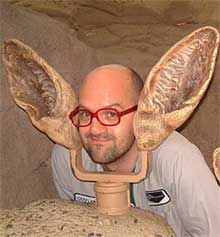 Ever since Max suggested i run interviews on the blog (and that's a looong time ago), i started thinking about whom i'd like to pester with naive questions. And whom i'd never dare to approach for an interview: those who are too famous, too brainy, too conceptual... too formidable for whatever reason one can imagine. Then one day you bump into one of them in a festival and he or she looks perfectly nice or open your email to find that they have sent you a kind message and you think "Well, i can do that, i can interview that guy." Vuk Cosic is certainly one of those "Formidables".